
Introducing Artificial Intelligence to Municipal Government
The Canton Public Schools (CPS) have taken an important first step by creating a working group to study the impact of artificial intelligence on the school system. By comparison, Canton’s municipal government is behind the curve—not only relative to CPS, but to many governments around the world that are already using AI to improve efficiency, transparency, and service delivery. Canton should establish its own municipal AI working group to explore how emerging technologies can responsibly streamline operations, increase productivity, and better serve residents.
My approach to AI is not about cutting jobs or reducing the workforce. It is about enhancing and expanding productivity with the staff we already have, while also strengthening the town’s cybersecurity posture. This includes optimizing town website content so residents can find information more easily, increasing access to public data through structured data tagging, building a centralized knowledge base using the town’s existing records, policies, and documents, and using AI to help detect, prevent, and respond to potential cyber threats. These improvements reduce frustration for residents and staff alike, improve system reliability and security, and free employees to focus on higher-value work.
Agentic AI refers to artificial intelligence systems designed to act with purpose, not simply respond to prompts. Unlike traditional AI tools that wait for instructions, agentic AI can understand a goal, plan the steps needed to achieve it, take action using available tools or data, and adjust its behavior based on results. In practice, this allows agentic AI to manage multi-step tasks such as optimizing operations, monitoring systems, or executing workflows with minimal human intervention. It represents a shift from AI as a passive assistant to AI as an active operator—always guided by human intent and oversight.
For municipalities, this means moving from reactive administration to proactive operations. Instead of staff manually monitoring issues and coordinating responses, agentic AI systems can be assigned clear goals—such as reducing response times, improving service delivery, or controlling costs—and then carry out the steps needed to achieve them. Examples include continuously reviewing budgets and contracts to flag potential cost overruns, automating permit reviews and inspection scheduling, managing facilities and energy usage more efficiently, and triaging resident requests across departments. When implemented correctly, agentic AI helps municipalities do more with existing staff, improve transparency and accountability, and deliver faster, more consistent services—while keeping policy decisions and final approvals firmly in human hands.
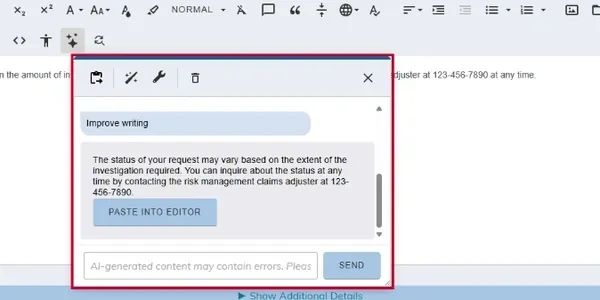
Many of these AI applications can integrate with the town’s existing technology stack and represent “easy wins” with relatively low implementation costs. Established public-sector tools—such as CivicPlus chatbots and AI content-editing assistants—are already designed specifically for municipal use and compliance.
Introducing new technology in a large organization can understandably meet resistance, as change is difficult and often disruptive. However, when rolled out thoughtfully—with training, transparency, and clear goals—employees, town officials, and residents ultimately benefit. Canton should embrace AI responsibly and deliberately, capturing real efficiencies and cost savings while modernizing how town government operates. Done right, AI can make local government more effective, more accessible, and more responsive to the people it serves.