Specialized Energy Code Article 33 - Canton MA
I believe warrant article 33 for the May 2026 Annual Town Meeting deserves careful and comprehensive review before adoption.
The Specialized Code primarily applies to new construction and does not address the majority of Canton’s existing housing stock, which accounts for most fossil fuel consumption and building-related emissions. If our long-term goal is meaningful carbon reduction, focusing exclusively on new homes and new buildings will produce only incremental results compared to the broader challenge of retrofitting existing structures.
Under the Specialized Code, new construction would be required to incorporate solar-ready, heat-pump-ready, and EV-ready infrastructure. While some residents and developers may welcome those features, others may not want or need them at the time of construction. Mandating these upgrades increases upfront construction costs, which ultimately affects housing affordability and home prices in an already expensive market.
From a commercial standpoint, we also need to consider competitiveness. Just about all neighboring towns in Norfolk County have not adopted the Specialized Energy Building Codes. If Canton adopts stricter building requirements than surrounding communities, it could discourage certain commercial or mixed-use development projects from locating here, particularly when developers are comparing permitting costs and regulatory environments across municipalities and states. Economic development decisions are often sensitive to cost differentials. Adopting this could have impacts on our new growth revenue and permit local receipts which the town relies on for the operating budget.
In practical terms, the compliance costs would fall primarily on the relatively small number of residents and businesses building new structures. While the Town may qualify for up to $1 million in Climate Leader Community grants, that funding is not guaranteed and may decline as more communities participate. Funding could also disappear completely if there's a change in the governor this November. The cumulative cost of complying with the Specialized Code could exceed the grant benefit, meaning new builders and buyers effectively shoulder the burden. This article would effectively create a new building tax that would be exclusive to Canton and may impact our building permit revenue which could impact other town services.
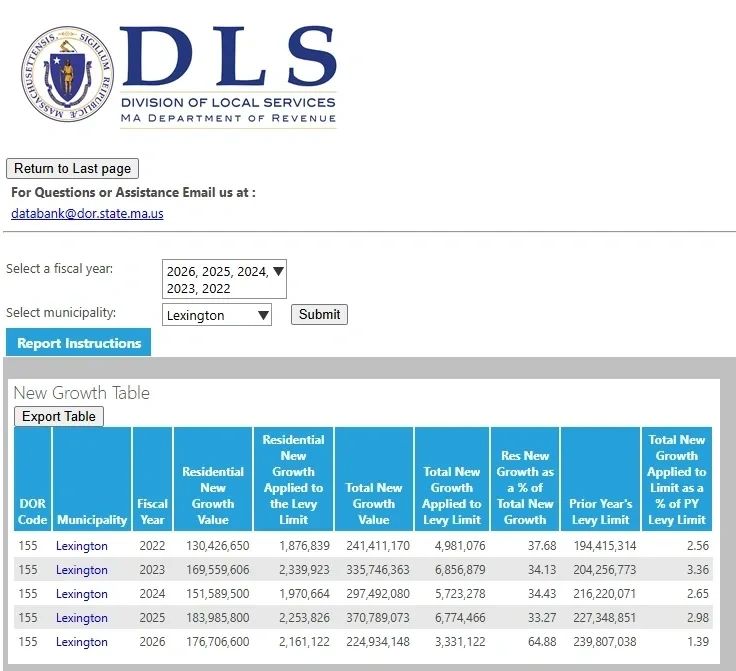
Let's examine the impact of new construction grown for the town of Lexington which recently implemented the specialized energy codes in calendar year 2024 or fiscal year 2025. As you can see from the Division of Local Services (DLS) new growth table, the total new growth applies to the levy limit for the town of Lexington decreased by about 50%. When your levy decreases by this much on new grown - the amount the next annual budget increase will be nominal, compared to the prior fiscal year which will cause financial stress on operating budgets, additional services, and labor contracts. Polices like the specialized energy codes will impact commercial and industrial business in our town as business will choose to more to other towns or states with less restrictive building codes. In the fiscal year 2026, Canton has some of the lowest commercial and industrial new growth on record according to the DLS, so perhaps the town should revaluate other towns over the next couple of years to make sure Canton has a steady stream of new growth added to the levy before proceeding with this policy. I suggest revisiting this after studying the economic impact on the other towns operating budgets, how new growth is impacted, and how building permit local receipts are impacted.

Proponent of Article 33 at this years Town Meeting have suggested that housing is booming as a result of passing the new regulation without providing any data. The data above from the DOR Division on Local Statistics shows the opposite tend on total new growth value and total new growth applied to the levy limit. What we are actually seeing is a 50% drop on total new grown applied to the levy limit when fiscal year 2025 is compared to fiscal year 2026.
If we are serious about climate goals, we should focus on measurable strategies that address existing municipal and residential buildings, fleet transitions, and energy efficiency retrofits — areas where the largest emissions reductions can be achieved.
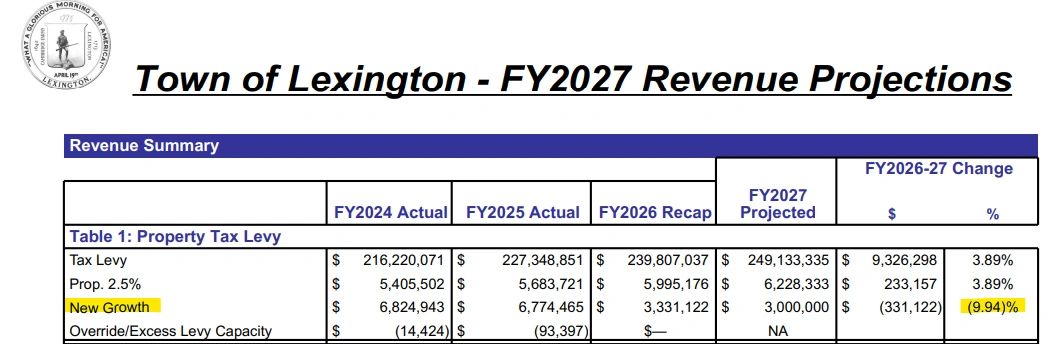
For fiscal year 2027 we're seeing projected new growth revenue fall even further compared to the fiscal year 2026 decrease of 50%