Canton Climate Action Plan Review
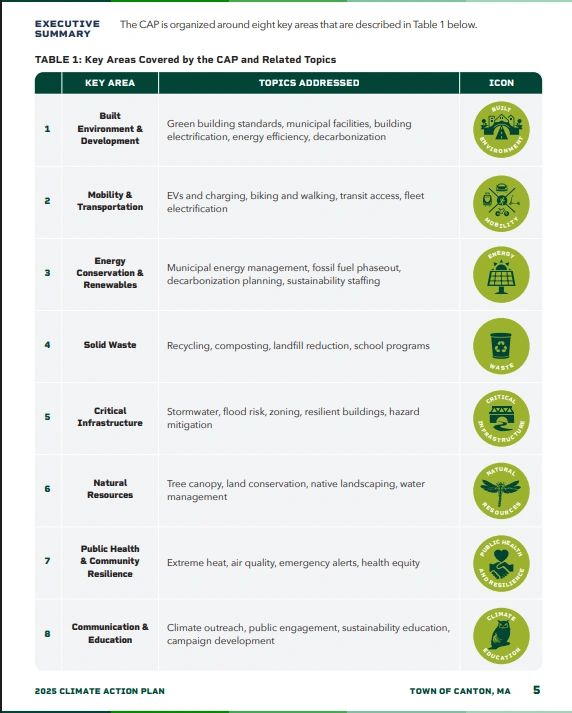
Canton has released an Executive Summary of its Climate Action Plan built around eight key focus areas. Let’s walk through several of these and examine how they translate into practical, affordable implementation.
1. Built Environment & Development
The plan promotes green building standards using third-party frameworks such as LEED (Leadership in Energy and Environmental Design) and National Green Building Standards (NGBS). These frameworks can improve efficiency and sustainability, but they also increase upfront project costs and design complexity.
For example, recent high-performance municipal buildings in Massachusetts have required significantly higher capital investment than conventional construction. Before committing to multiple large building projects in terms of financing, the town should evaluate debt capacity, long-term capital plans, and lifecycle cost savings to determine feasibility.
Equally important is strengthening how projects are managed. I support creating a Department of Public Buildings led by a Municipal Buildings Chief of Operations to oversee construction and renovation projects, standardize procurement practices, and ensure professional project management and accountability.
2. Mobility & Transportation
The town has invested in electric vehicle charging infrastructure but has been slower to transition the municipal fleet toward electric and hybrid vehicles. Fleet conversion is one of the most measurable and controllable ways to reduce municipal emissions.
During my time on the Finance Committee, I encouraged earlier adoption of hybrid and electric vehicles. Progress has been uneven. Moving forward, fleet replacement schedules should explicitly evaluate electric and hybrid options wherever operationally practical.
Other Massachusetts agencies — including statewide fleets — have incorporated hybrid vehicles successfully. Canton should adopt a structured fleet transition plan tied to replacement cycles and total cost of ownership.
3. Energy Conservation & Renewables
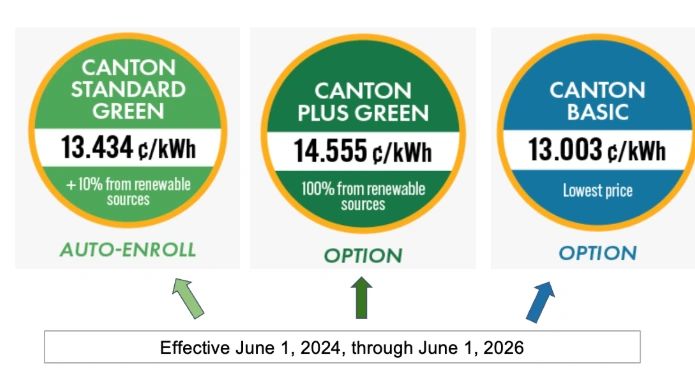
Energy conservation and renewable sourcing are core elements of the Climate Action Plan and connect to programs like Canton Electricity Choice. Residents have the option to select higher-renewable supply options at a premium cost.
Adoption of premium green supply options has been limited, which suggests affordability remains a major barrier for many households. Rising energy prices make voluntary cost add-ons difficult for residents to absorb.
4.Solid Waste
During the next Select Board term, the town will have the opportunity to negotiate a new solid waste contract. My platform supports including composting services in the next contract to help reduce overall trash tonnage and disposal costs.
I also propose adding yard waste pickup, with composting processed at the Pine Street location where feasible. Expanding diversion programs like composting and yard waste collection can reduce landfill use and improve environmental outcomes while making services more convenient for residents.
5.Critical Infrastructure
I am committed to supporting and strengthening the town’s stormwater management program. This includes encouraging the installation of rain gardens and other low-impact development features on both new and existing properties to reduce runoff and flooding risk.
Expanded yard waste collection will also help keep storm drains clear and improve drainage performance. In addition, I recommend a comprehensive review of all dams and related water control structures in town to assess condition, maintenance needs, and flood risk mitigation.
6. Natural Resources
We need to focus on increasing our tree canopy and we need to offer a tree planning program for our residents similar to the way the City of Quincy does. Water management needs to be reviewed and the use of chemicals added to our waterways to treat invasive plants. We need to focus on other alternatives to using chemicals in our waterways, as this can impact our drinking water.
7. Public Health and Community Resilience
While the town cannot directly control outdoor air quality or extreme heat events, we can improve preparedness and response. That includes designating indoor clean-air and cooling locations where residents can find filtered and conditioned air during extreme weather events.
Emergency communications should use multiple redundant channels, including:
reverse 911 systems
social media platforms
town message boards
press releases
public signage
digital alerts
A layered approach improves reach and reliability.
8.Communication & Education
My approach is to build on — not replace — the work already done by the Sustainability Committee. I support continuing and strengthening their outreach efforts using existing budget resources, while improving coordination, measurement, and public visibility of programs and results.
Building Green House Gas Reduction Goals
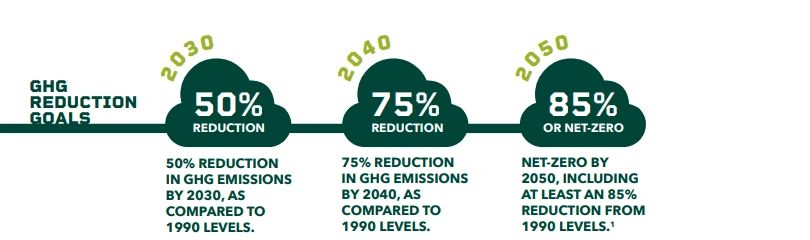
Now let’s examine whether the Climate Action Plan can realistically achieve a net-zero target by 2050 in terms of municipal buildings and the town’s debt capacity.
The town and school system together operate roughly 25 buildings. At a simplified level, reaching net-zero across the portfolio by 2050 could imply upgrading approximately one building per year over the next 25 years. That would require significant capital investment for deep energy retrofits, electrification, and building system replacements.
Given current debt capacity limits, the town may not be able to finance upgrades at that pace without relying on debt exclusions or overrides. Those financing tools, if used repeatedly, would increase property taxes. The key policy question is not whether sustainability improvements are worthwhile, but how to sequence and fund them responsibly so that costs remain manageable for residents.
A more practical path may include prioritizing the highest-impact buildings first, capturing available state and federal grants, using performance contracting, and aligning upgrades with scheduled capital replacements. If outside funding sources expand, the timeline and affordability picture could change significantly.
The central issue for residents is affordability: what level of tax impact is acceptable, and how should sustainability goals be balanced with fiscal constraints?
Town and School Building Inventory That Needs To Be Converted to Net-Zero By 2050
1. Memorial Hall (Town Hall) — 801 Washington Street
2. Canton Public Library — 786 Washington Street
3. Police Station — 1492 Washington Street
4. Fire Station Headquarters — 99 Revere Street
5. Ponkapoag Fire Station — 7 Sassamon Street
6. Department of Public Works Garage — 160 Bolivar Street
7. Senior Center — 500 Pleasant Street
8. James Moran Water Treatment Facility — 19 Pecunit Street
9. Edward Sullivan Water Treatment Facility — 500 Neponset Street
10. William Armando Recreation Center — 92 Pleasant Street
11. Pequitside Main House — 79 Pleasant Street
12. Pequitside Carriage House — 79 Pleasant Street
13. Pequitside Horse Barn — 79 Pleasant Street
14. Ponkapoag School (Town Use / Rental Facility) — 2438 Washington Street
15. Gridley School (Parks & Recreation Programs) — 314 Washington Street
16. Water/Sewer Garage — 44 Pine Street
17. Canton High School — 900 Washington Street
18. Galvin Middle School — 55 Pecunit Street
19. John F. Kennedy School — 100 Dedham Street
20. Lieutenant Peter M. Hansen School — 25 Pecunit Street
21. Dean S. Luce Elementary School — 45 Independence Street
22. Rodman Early Childhood Center — 960 Washington Street
23. Paul Revere Heritage Site (Copper Rolling Mill)
24. Paul Revere Museum of Discovery & Innovation (MoDI)
25.St. Gerard's
Easy Win's
The low-hanging fruit in these key areas — actions the town can take within the operating budget without increasing the property tax burden — includes transitioning municipal vehicles to electric and hybrid models, adding compost and yard waste pickup to our trash services, launching a tree-planting program to expand the town’s canopy, establishing a modern emergency alert system, and continuing to educate residents through the Sustainability Committee.
Below is an image of the Executive summary. You can find the full document here.